With an increasingly active one year-old, time to blog has a way of slipping away from you. When you offer to organize your church's US home-stay/ English language program, any and all time to blog goes flying out the window. All that to say, I've been a bit busy over the last months to get much of any writing done. Sorry.
I've been so focused on this program because I am genuinely excited to be assisting in it's creation. Our church, Sapporo EV Free, has done short term US trips in the past, but this will be the first, to my limited knowledge, that will be home-stay and language based. Tourism will definitely play it's part. But if I've learned anything from teaching, it's the power of integration. I want our students to get first hand language experiences in America and to have a great time while doing it. The home-stay component as well excites me. I'm so excited to hear stories of new relationships that develop!
The trip is coming up faster than I realize. The group, lead by my dear hubs and the Pastor's wife, Y, will leave Japan on the 29th and stay until August 5th. While they're in California they'll be staying with members of Soma Christian Church and taking daily trips to see not only touristy places like Yosemite or the beach, but also daily life things like the grocery store and mall.
I'm almost done with the daily lesson plans, but I have a few questions for you before I press "print."
If you were traveling to a foreign country, what would you like to see? What questions would you like to ask?
If you have traveled to a foreign country, or hosted an international student, what are some tips you'd like to share with our Japanese English-students? Any blunders?
Leave a comment below.
Showing posts with label language. Show all posts
Showing posts with label language. Show all posts
Sunday, July 14, 2013

Tuesday, May 21, 2013
Silly-Jilly: Lost in Translation
Anyone who has ever typed something into Google Translate can tell you, the word you want to use doesn't always convey the meaning you hope it does. Some rare words translate perfectly; conveying the precise meaning from first language to second. Others... well, not so much. "Silly" is one such word.
Sunday at church as a friend, Y, and I bowed to pray Jillian took the opportunity to pet Y's hair and stick her, Jillian's, foot into Y's praying hands. When we said our "Amen"s I told my friend. "Jillian is such a silly girl" in English and gave Jilly a kiss on the head. I asked Y, who speaks fluent English, if there is a word that translated well for silly. The closest I've been able to think of don't really convey the right shade of meaning. "Tannoshii" is more like fun or enjoyable. "Omoshiroii" is like interesting or enjoyable. "Kawaii" is cute. But silly is more like a combo of the three with a little bit of "Henna" (weird) thrown in.
The word she gave me I didn't even commit to memory because when I asked her if it was a good or bad image, she said bad. Her word translated to something like foolish.
I was mortified. This woman, and how many other English-speaking Japanese people, think I've been calling my daughter foolish! I quickly explained that silly has a positive image. Perhaps in the past it was negative, but now it's "Wee Sing in Sillyville"; it's "Silly Songs with Larry"; it's our own Silly-Jilly. Definitely not negative.
The whole encounter got me thinking about how many other words, or actions I've been using that are COMPLETELY misinterpreted. Probably a lot. I recently found out that when Jillian waved "hello" to people, even in response to "Konnichiwa" people think she's waving "bye-bye". Poor baby has been inviting people to come play and they've been thinking she wants them to leave. We should probably practice bowing rather than waving, but I hesitate because the waving is so darn cute!
I know I'm bound to make, or discover, more mistakes in my word choice. I just hope none of them give the impression I'm speaking ill of my daughter, or other people for that matter.
Sunday at church as a friend, Y, and I bowed to pray Jillian took the opportunity to pet Y's hair and stick her, Jillian's, foot into Y's praying hands. When we said our "Amen"s I told my friend. "Jillian is such a silly girl" in English and gave Jilly a kiss on the head. I asked Y, who speaks fluent English, if there is a word that translated well for silly. The closest I've been able to think of don't really convey the right shade of meaning. "Tannoshii" is more like fun or enjoyable. "Omoshiroii" is like interesting or enjoyable. "Kawaii" is cute. But silly is more like a combo of the three with a little bit of "Henna" (weird) thrown in.
The word she gave me I didn't even commit to memory because when I asked her if it was a good or bad image, she said bad. Her word translated to something like foolish.
I was mortified. This woman, and how many other English-speaking Japanese people, think I've been calling my daughter foolish! I quickly explained that silly has a positive image. Perhaps in the past it was negative, but now it's "Wee Sing in Sillyville"; it's "Silly Songs with Larry"; it's our own Silly-Jilly. Definitely not negative.
 |
| Someone needs to warn Larry that he might not translate well into Japanese. Image credit |
I know I'm bound to make, or discover, more mistakes in my word choice. I just hope none of them give the impression I'm speaking ill of my daughter, or other people for that matter.
Wednesday, February 13, 2013
Bringing Laughter to the Tutoring Center
Some time last year it hit me that living in Japan as a limited language foreigner is a lot like being a small child. I can't read. I can't write. I don't have a high vocabulary. I may even be worse off than a small child; even they know the cultural expectations and processes like lining up their shoes, something I ALWAYS forget to do.
I guess it's fitting that I just started attending an after school tutoring program geared towards young Japanese children to improve my Japanese.

Kumon is pretty much standard around here. I'm willing to bet there are more Kumons in Japan than there are Starbucks in California.
Like I said, it's an after-school tutoring program. Kids go there to practice reading, writing, math, and English. Often, foreigners, like me, will go to learn kokugo (the country's language) Japanese, rather than Japanese geared towards foreigners. The benefit is you can learn Japanese how Japanese do. You have the vocab; the idioms and sayings; the common children's stories; and other things that make language what it is.
My first day was last Thursday. What a humbling experience, let me tell you! There is nothing like reading a kindergarten reading passage out loud while a room full of 7 and 8 year olds watch you in amusement as you, a grown adult, stumble through.
People, so you understand, although I've never been the best student, I'm grade-level at the very least. Being semi-illiterate is a bit of a blow to my self-esteem. Having that fact highlighted by 1st and 2nd graders turns the whole thing into a comedy show. I'm choosing to be glad I can bring laughter to the otherwise quiet classroom. ;)
Then, I had to fill in some worksheets to have the teacher grade. When she took her red pen to my work and started circling EVERYTHING I nearly died.

Until I remembered circles mean correct. It's "X"s that mean wrong. Blargh, even how they grade is different!
Turns out I did well on my first worksheet, and only had one error in my handwriting (Yes, handwriting is graded, too).
I go back today with a stack of homework for them to grade. This time, I'm hoping for lots of red pen circles!
I guess it's fitting that I just started attending an after school tutoring program geared towards young Japanese children to improve my Japanese.
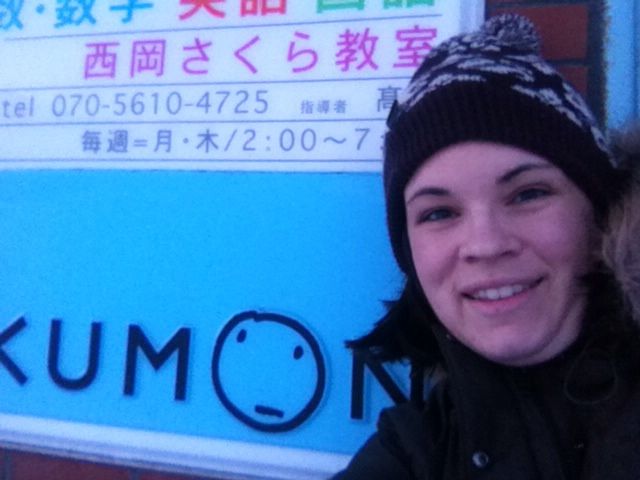
Kumon is pretty much standard around here. I'm willing to bet there are more Kumons in Japan than there are Starbucks in California.
Like I said, it's an after-school tutoring program. Kids go there to practice reading, writing, math, and English. Often, foreigners, like me, will go to learn kokugo (the country's language) Japanese, rather than Japanese geared towards foreigners. The benefit is you can learn Japanese how Japanese do. You have the vocab; the idioms and sayings; the common children's stories; and other things that make language what it is.
My first day was last Thursday. What a humbling experience, let me tell you! There is nothing like reading a kindergarten reading passage out loud while a room full of 7 and 8 year olds watch you in amusement as you, a grown adult, stumble through.
People, so you understand, although I've never been the best student, I'm grade-level at the very least. Being semi-illiterate is a bit of a blow to my self-esteem. Having that fact highlighted by 1st and 2nd graders turns the whole thing into a comedy show. I'm choosing to be glad I can bring laughter to the otherwise quiet classroom. ;)
Then, I had to fill in some worksheets to have the teacher grade. When she took her red pen to my work and started circling EVERYTHING I nearly died.
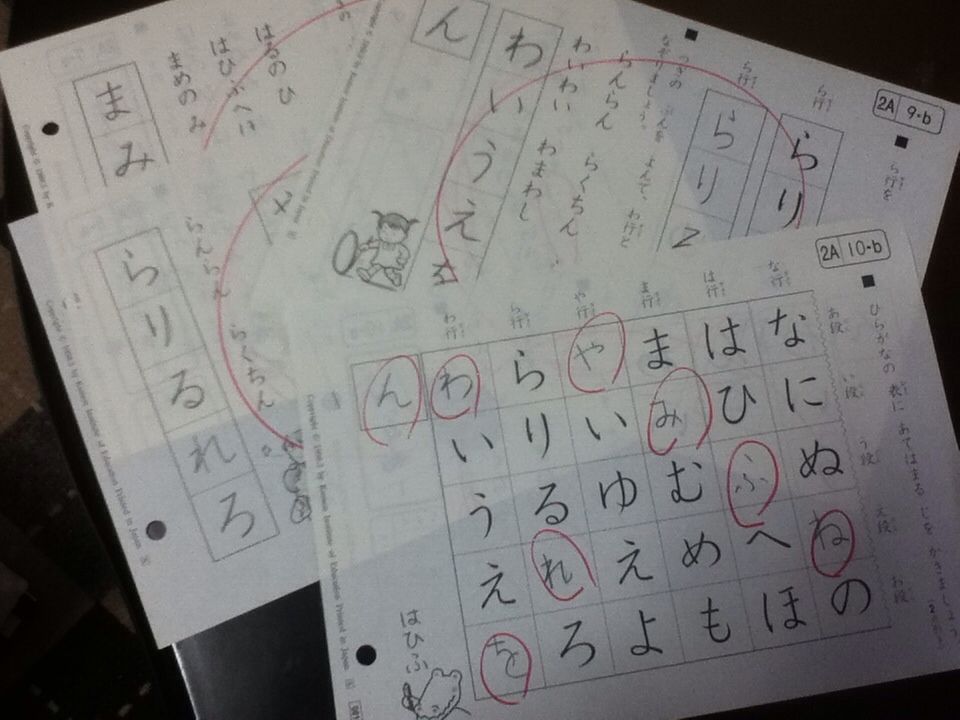
Until I remembered circles mean correct. It's "X"s that mean wrong. Blargh, even how they grade is different!
Turns out I did well on my first worksheet, and only had one error in my handwriting (Yes, handwriting is graded, too).
I go back today with a stack of homework for them to grade. This time, I'm hoping for lots of red pen circles!
Saturday, January 28, 2012
Japanniversary week: Words I never thought I'd know (and use)
We're a day away from our 1st Japanniversay. If you haven't submitted your guesses for the contest, it's not too late. Click here for details. Also, you can still possibly win a prize if your comment on any post in the past 6 days is chosen at random, so get to commenting!
---------------------------------------------
Learning language has been one of the biggest challenges about living in Japan. This is a challenge we anticipated of course. And over the past year, I can confidently say we've made great progress in our abilities to listen, speak, read and write.
Through out the year, we've learned many words through daily conversation, eaves-dropping, tv and fliers. Sometimes I learn a word that I think is soooo random, yet I find my self using it frequently.
I've made a list of some of our favorite random words in Japanese. I hope you get a kick out of them, like we have. If you're feeling adventurous, try them out for yourself.
かんそう kanso:
Dry air, as in "every problem you are experiencing from your runny nose to you dry skin is caused by kanso."
ふうふ fu-fu:
married couple. When we arrived I was curious about this word since people referred to us as Borba-fufu.
あみもの amimono:
knitting/crocheting. Not to be confused with aMAImono (あまいもの) which means sweets.
Sample sentence-
私は編み物をしながら、甘いものをたべます。
"Watashi wa amimono o shinagara, amaimono o tabemasu."
While I knit, I eat sweets."
にんしん ninshin:
Pregnancy. I actually had to search this one out, but since learning it I've used it on a daily basis!
Sample sentence-
妊娠しています。
"Ninshin shite imasu."
I'm pregnant (I am doing pregnancy).
Be careful not to say,
妊娠です。(ninshin desu) which means "I am pregnancy", or you'll get a lot of confused faces when you announce your big news. (Yes, I know this first hand.)
あぶない abunai:
Dangerous. I'm not sure why we love this word. probably because it can be used on it's own as a warning. It has become a daily expression in our home. We enjoy pointing our the dangerous things all around us like snow, ice, scissors on the couch, blowdryer near the sink.... you get the idea. :)
Sample sentences-
危ない!
"Abunai!"
Danger!
or
危ないですようね!
"Abunai desu yo ne!"
It's dangerous, huh?!
ストーブ sto-bu:
heater. I was surprised to learn sto-bu didn't mean stove, it means heater. I thought for sure ヒータ(hee-ta) would mean heater, but no. So don't tell people you cooked your dinner on the sto-bu. Okay?
ベイビーベド beibeee-bedo:
crib. While teaching an English lesson, I learned this word. my students we're confused about the meaning of "crib" so I drew a picture.
"Oh.... "beibeee bedo"!"
::facepalm::
I figured it would be a katakana English word (an english word pronounced like Japanese) but I assumed it would be クリブ (ku-ri-bu). But, I guess beibee-bedo works too, right?
Do you have a favorite word or phrase in Japanese?
Tuesday, December 27, 2011
The Art of Embarrassment
We were asked to be actors in the church play this Christmas. We weren't quite tricked, like last time, but we definitely didn't know exactly what we were agreeing to either.


Our church performed a shortened version of "The Pilgrim's Progress" by John Bunyan. We didn't know this until half-way though the first read-through. I naturally thought the Christmas play would be more nativity related. I was quite confused when there was no pregnant lady traveling with her fiance, & when the main character battled a monster named Apolyon. Stephen, who's read the book, on the other hand, guessed right away what the play was.
I was asked to be the wife/mother. I assume because ever expanding belly makes me look matronly. Stephen was my son.
The feat of learning lines in Japanese and knowing when to say them gave me a bit of a panic attack. Thankfully, our parts were small. And we didn't have to memorize our lines.
When my English students found out I was going to be in a play in Japanese, they asked about coming to church to watch. So, Christmas morning, two of my English students came to our church Christmas party to watch Stephen and I looking foolish reading lines in Japanese with bad American accents.
Everyone in the play was very gracious about our performance. Which was good, because when ever I said a line, the whole audience laughed. ( I don't think that is how the author intended it)
It was a light hearted production, and no-one took themselves too seriously. Well other than this guy...
It was a great experience. It forced us to learn some sentences we otherwise wouldn't know, and the promise of seeing their English teacher be embarrassed got two of my students to come to church.
Friday, December 9, 2011
5 words/phrases for winter
It's cold!
It feels like this phrase has been on repeat around our house for the past few week. (I have a feeling, it's not going to stop anytime soon. )
We've officially arrived in winter. The snow is sticking, the nights are below freezing (as are most of the days), and I've been wearing more layers than an onion!
I asked a few of my English classes to share 5 common Japanese words & phrases for winter in Hokkaido. Even if you don't live in the tundra, I hope you try them out!
1) しばれる (Shi-ba-re-ru) : "colder than cold!"
If your freezing your behind off, try saying this phrase.
2) つらら (tsu-ra-ra) : "Icicle."
(I've been pointing out all the tsurara I see on houses and dripping from the hoods of cars since learning this word)
3) さむいいですね! (sA-mu-i dess neh!) : "It's cold, Isn't it!" (or, "It sure is cold!")
This is equally as popular in the winter as "Atsui dess neh!" is in the summer ("it's hot, isn't it!")
4) そうですようね!(so dess yo neh!) : "Yeah it is!"
This is used to agree with the previous sentence.
5) ゆきがふりましたね! (yu-ki ga fu-ri-ma-shta- neh!) : Literally "Snow fell, right!?" My student told me it's like pointing out the obvious. If a lot of snow fell, you would say this. (like the English equivalent of "It's really coming down out there")
Saturday, October 1, 2011
Practical language
Language is awesome. The more I learn the more amazed I am at its beauty. Like euphemisms and expressions. I love how there are so many ways to convey the same thing.
Here's a list of my most recent, favorite expressions is English and Japanese:
I'm Eating for two.
I have a bun in the oven.
I'm in the family way.
I'm with child.
I'm craving pickles and ice cream.
We're expecting.
I'm preggers.
I'm knocked up.
My eggo is preggo.
I'm on stork watch.
I'm gestating.
I'm preggtastic.
妊娠しています(Ninshin shite imasu)
おおめでた(Omedeta)
できちゃった(Dekichatta)

Yep, it's true. There's a baby on the way!
Monday, September 12, 2011
Language Tests and Pretests
A few months ago, Stephen and I decided to challenge our language learning by taking the Basic level of the Japanese Language Proficiency Test (JLPT) this coming December. Shortly after that, I jumped into the tangled maze that is the JLPT application process. Little did I know when I began that this particular test has several hurdles to jump, I can only assume, to weed out non-proficient people.


Let me fill you in on the madness.
Pretest 1: purchase the applications.
In the States when I applied for the many tests I had to take to get through college and credentialling (CBEST, 3 CSETs, & 2 CLEPs) it was always as easy as going online clicking a few buttons and voila! you are ready to test. For this test, I had to purchase the applications from "a book store in (my) area." That's really all the official website said.
I failed my first attempt at finding the test and ended up walking out of the store in shame.
After talking with a friend who took the test last year, I found the right bookstore, the right floor, and the right counter to find the application.
Pretest 1: PASS
Pretest 2: fill out the applications.
"No big deal," you are most likely thinking right now. NO! it WAS a big deal. Each application came with (I kid you not) a 53 page(!) instruction booklet. After my initial shock, I learned to love the instruction booklet, and I am sure it is the only reason I knew to do the next 3 steps.
Pretest 2: PASS
Pretest 3: take a passport style photo to include with your application.
WHAT?! Never in the history of education or test taking have I needed to included a photo in with my application. And of course it had to be a certain size and dimension. fortunately for us, our supervisor, Tim, pointed out the passport photo booth at the mall near our house, when we had just arrived in Japan.
Pretest 3: PASS (even if they weren't the prettiest pictures)
Pretest 4: Pay for application at the post office.
I mentioned in my last post about how Japan deals with the lack of checks. so, rather than including a check with my application we had to head to the post office and pay for each application, then include the receipt(with the id number that corresponded to the id number on the application) in the envelope.
Pretest 4: PASS (thanks to the very kind clerk)
Pretest 5: Mail the application via special certified mail.
I only knew how to ask for this because my now beloved instruction manual told me. And really, after all the other tests, this one was not only easy-breezy, it was my favorite one because it was the LAST!
Pretest 5: PASS
We are now just waiting for our test voucher to come in the mail, when I am sure we will have a whole new set of hurdles to jump. Oh, and studying Japanese, because after all this work, I'd kind of like to pass the REAL test in December.
Thursday, July 21, 2011
Adventures in cooking
I love to cook. so much so that when asked by a colleague what I wanted to do to get into the community more I said join a cooking class, with out even a thought.
Of course, I had no idea how to go about FINDING a cooking class, much less signing up for one.
To my great joy and surprise, while wandering aimlessly through the underground shopping center at the train station, we walked straight into a cooking school, which just happened to be offering sample lessons!
In my best Japanese, I awkwardly asked for information about the class. S-Sensei ran back to the desk and brought me a floor guide to the shopping area.
"Yes, I know I'm in Passeo."
Let's try this again...
"I like to cook. I learn to cook?" (Yes, this is direct translation of my awkwardness, S-sensei deserves a raise for dealing with me!)
I was able to sign up for a class a few weeks later.
The class itself was really fun. After I got over my initial terror of having to learn something new in Japanese, I had a blast. S-Sensei was eager to practice her English with me, so between the two of us trying, we understood each other pretty well.
Here's the cake we made in the sample class.

Hands down, the funniest part of the class was making the whipped cream. As I learned from my mom, when whipped heavy cream first turns into whipped cream, and then into butter/buttermilk. So, when I was using the hand mixer on the whipped cream and saw it reach the proper consistency I asked S-Sensei, if it was okay. She said, "A little more." and walked away.
I watched the whipped cream start to develop chunks and gradually separate into butter and butter milk. But I kept the mixer going, because the teacher said, "a little more." Maybe she wanted me to make butter for the cake filling.
When she came back and saw the butter, she was quite surprised. Apparently she had never seen that happen before! (If you haven't seen it either, I recommend trying it out. Quite a fun cooking science experiment!)
Me, S-Sensei, and my beautiful cake (with second-try whipped cream filling)

I had a great time, and am excited to go again to another sample class that S-Sensei invited me to.
Monday, May 16, 2011
The Trials and Tribulations of Learning Japanese.
Japanese is filled with English words said with a Japanese accent.
teburu (table)
ko-hi (coffee)
bah nah nah (banana)
takushi (taxi)
hanbah-gah- (hamburger)
Oren jee juu suu (orange juice)
And there are so many more. More times than I care to count, I have asked what to call something in Japanese and was told an English word. I've come to the conclusion, that if I can't think of the word in Japanese, I should just say it in English with an accent.
This love of English words does have it's downside though. When I try to order a caramel macchiato at Starbucks, I get blank stares unless I say "kya me ru ma ki ah to. " Even though the menu is written in English over the barista's head.
Or if when talking about our English class, I mention the text book and no one can seem to figure out what I am talking about. But then some light bulb goes off and some one says, "Ohh, the tekisuto." and now, miraculously everyone knows EXACTLY what I'm talking about.
This past week, Japanese English kicked my butt again.
At church last week, Sunday, the pastor was saying something about Tohoku, and our church going to "BorAntia."
Hmm, Borantia must be the city in Tohoku where they are serving.
But 3 days later, a non-church member was talking to me about BorAntia Japanese classes. And how I should take one. And how a mutual friend went to BorAntia in Tohoku.
Huh, is BorAntia a university, or an organization that does both Japanese classes and tsunami relief? Just nod and smile.
The next day, I was asked by a church member if Stephen and I were going to BorAntia in Tohoku.
It wasn't until Friday that I figured out that people were not saying the name of some city of organization. They were saying "BorAntia" the Japanese way to pronounce "Volunteer".
Our church went to volunteer in Tohoku, and my friend was suggesting volunteer Japanese classes that were held at a community center.
So, this week I have learned that in order to learn Japanese, I must relearn English.
Thursday, March 24, 2011
The "Number 2"
There are basically 3 hair cuts in Japan.


(1)Long, (2) short and (3)REALLY short
1)
2)
3)
After my first trip to the hair salon, I am now the "proud" owner of cut number 2.
Now, I didn't walk into the hair salon with the intention of having 1/2 of my hair chopped off. Nor did I expect to have bangs when I walked out, but here I am.
After been in Japan for about 7 weeks, I decided I needed a hair cut. Nothing fancy, just chopped at my collar bone, with a few layers. I asked my English-speaking neighbor where I could get a cut. She pointed to a sign down the street that read "Ka-to" (cut).
The shop was very close. Less than a 2 minutes walk. Inside, the hair dresser was working on two ladies at once: one getting a perm, and the other just finishing up a hair cut. I was able to have a seat quickly and explain in my broken Japanese, and her Broken English, along with a lot of hand motions, that I wanted my hair cut to here (points to collar bone). "Layers?" She asks me. Horray, I was worried how I would explain that. "yes," I say emphatically, "a few."
As she is piling the hair on my head to begin, the lady who just stood up makes a comment about gaijin (foreigner) hair and comes over to feel mine.
Once she goes, the hair dresser and I start up a long converstation filled with short sentences like "I come from California. Where do you come from?" "I like to cook." "I teach English." Only in Japanese. Mixed with random English from her.
A bit later, she shows me myself in the mirror. My hair had been cut to the right length, but no layers. If she hadn't have suggested it, I would not have asked. "Layers?" I ask.
"Ok" comes the reply. And she proceed to lift up random pieces of hair and start chopping. My hair is getting shorter by the second. I work hard to mask the panic from showing on my face. When she is finished, she hands me the mirror again, and I notice I now have bangs (something I haven't had since I was 9!).
Thanking her, I paid and rushed home.
I am starting to appreciate my new hair cut, but am continuing in my montra of "hair grows."
I think I'll go back to her again, at least once more. But next time with a picture of what I want.
Enjoy the "after" photos.
Monday, July 26, 2010
the long and the short of our time at language school
While we have been stateside, I have often lamented that there is nothing worth blogging about. No big ministry events, no Japanese coming to Christ, no cultural mishaps. while we have been at language school I have had the opposite problem. There have been so many paradigm shifts, interesting people to meet, stories to hear, and events to share about, that I feel I don't know where to begin, nor do I want to over whelm anyone. so for those of you whowould like the "Reader's Digest" version of our 2 weeks at language school, enjoy the headings and pictures below.
There are a lot of crazy sounds in the world.


But for those of you, like me, who enjoy really long blog posts, as long as there are pictures and short segments, read on!
Did youknow that the English language only uses 44 sounds, but there are many, many, many more used in the world. Most of them I would have said were nothing more than air escaping before coming to PILAT. I feel so very blessed to be learning Japanese, which has none of the SUPER crazy ones we learned.
Language is a natural human ability, not an academic subject.
Learning a language is more like learning to walk or run or ride a bike than it is like learning Math, or History. Because of this we should be using different methods. So if you see me watching Anime and writing down all the words I recognize, you'll know why.
We have wonderful friends!
These two weeks, we have been blessed to reside in the guest bedroom of our friends, Josh and Marilyn. We have felt so loved.
Mountains are steep and I am out of shape!
We enjoyed a 5 mile hike up and down a mountain, with our friends. I must say, I enjoyed the down part much more than the up part. Marilyn was kind enough to cite the elevation as the reason for my huffing and puffing. After reaching the top, I was pleased to enjoy the view.
Donuts baked at 14,110 ft just taste better.
On Saturday we drove above the tree line, to the top of Pike's Peak. At the top, we had to coax Stephen to walk within 30 ft of the edge. I was glad he conquered his fears to enjoy a donut and a cup of hot chocolate on a rock, over looking the Eastern Plains.
I am more excited, each day, to get to be a missionary.
What a treat it is to hang out for two weeks with 45 other missionaries in training. There is something to be said for the camaraderie that occurs when you are at the same stage of life as your community. I have so enjoyed sharing stories with missionaries to all over the world.
Thanks for hanging in there for the looooong post. :P

Friday, July 23, 2010
If I only had a camera cord
Packing for language school I was intentional about bringing my camera, camera charger, and laptop so I could communication with all of you about our experience here at MTI in Colorado. Yet, somehow it slipped my mind to pack the means of getting my photos onto my computer!
Grrrar.
I guess I'll have to post them when I get home.
Subscribe to:
Posts (Atom)
